The number of farms has declined across North America and Europe since the 1970s. To understand if supply management affects the rate of consolidation or attrition of dairy farms in Canada, it's important to consider many factors, not just statistics.
What are the factors contributing to this decline?
The number of people who continue farming – like all occupations – is influenced by personal and commercial factors like age, succession and investment plans, technology, land opportunities and costs, career specialization, labour competition, and unforeseen events.
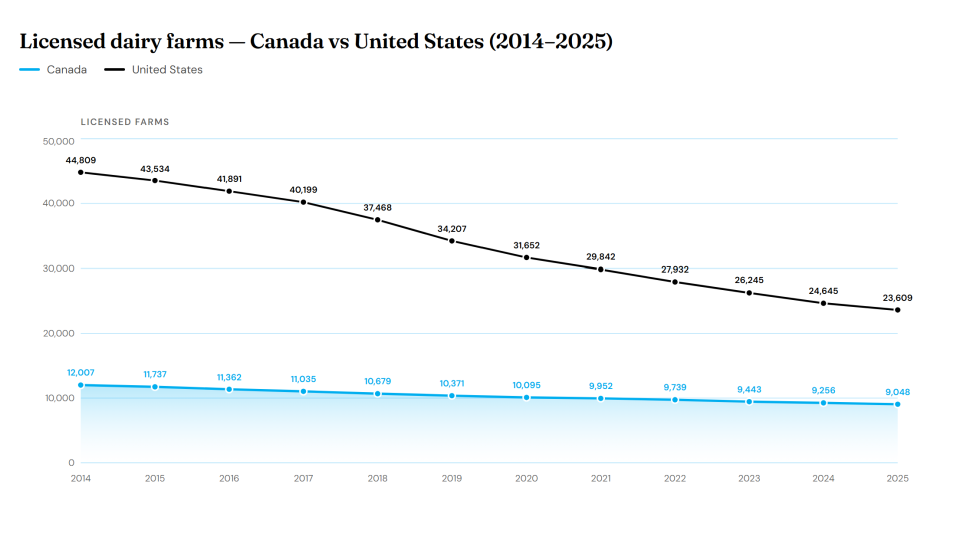
The percentage decline in dairy farm numbers over the last 50 years is similar in the United States and Canada – but the rate has been different. As shown in the graph below, the decline in number of U.S. farms actually sped up in the last decade, decreasing on average 5.7% annually while Canada's dairy farm numbers have decreased more steadily by 2.2% annually during that time. This suggests human decision factors like career changes or retirement are more likely to influence farm numbers in our more stable market here than in the US.
Do fewer farms mean fewer agriculture jobs?
Not necessarily. The dairy sector in Canada supports 270,000 jobs (direct and indirect) related to farming, processing and distributing of dairy products. For agriculture in general, the 2021 Census of Agriculture notes that technology has shaped farming and eased the workload. Farms are more productive (each person on the farm can routinely take care of more cows and more acres) and more specialized external experts are called on for specific tasks and challenges.
Fewer farms around the globe
The number of small farms is declining around the world. In the United States, Europe or Oceania, we note a similar tendency to having fewer farms, with more cows and milk produced on each farm. This trend is similar even if different countries apply different policies of support to their agricultural sectors.
Subsistence farming is a thing of the past. Farms are growing larger and becoming more sophisticated and specializing over time. This evolution goes hand in hand with an increasingly urban population and a wider range of career choices than there was 50 or 100 years ago.